Why cave-art ages are often minimum estimates
AI-generated symbolic cover. A researcher examines an ancient red hand stencil and calcite crust; symbolic reconstruction, not a site photograph.
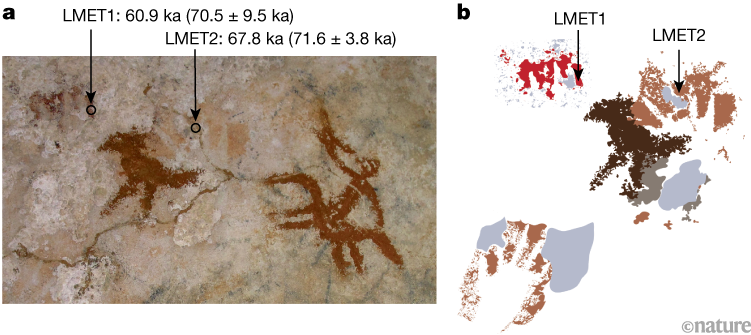
Very old cave images are known in Spain, but calling drawings around 42,000 years old the world’s oldest is no longer accurate. A study of Spanish caves published in 2018 dated some signs and hand stencils to more than 64,000 years ago; its authors associated them with Neanderthals. That is a conclusion about specific dated examples, not the age of every image in a cave.
In January 2026, another study reported a hand stencil in Sulawesi at least 67,800 years old. Such discoveries change our understanding of early art, but at least matters: a dated mineral layer can establish a minimum age for an image rather than its exact year of creation.