Bone strength depends on load direction
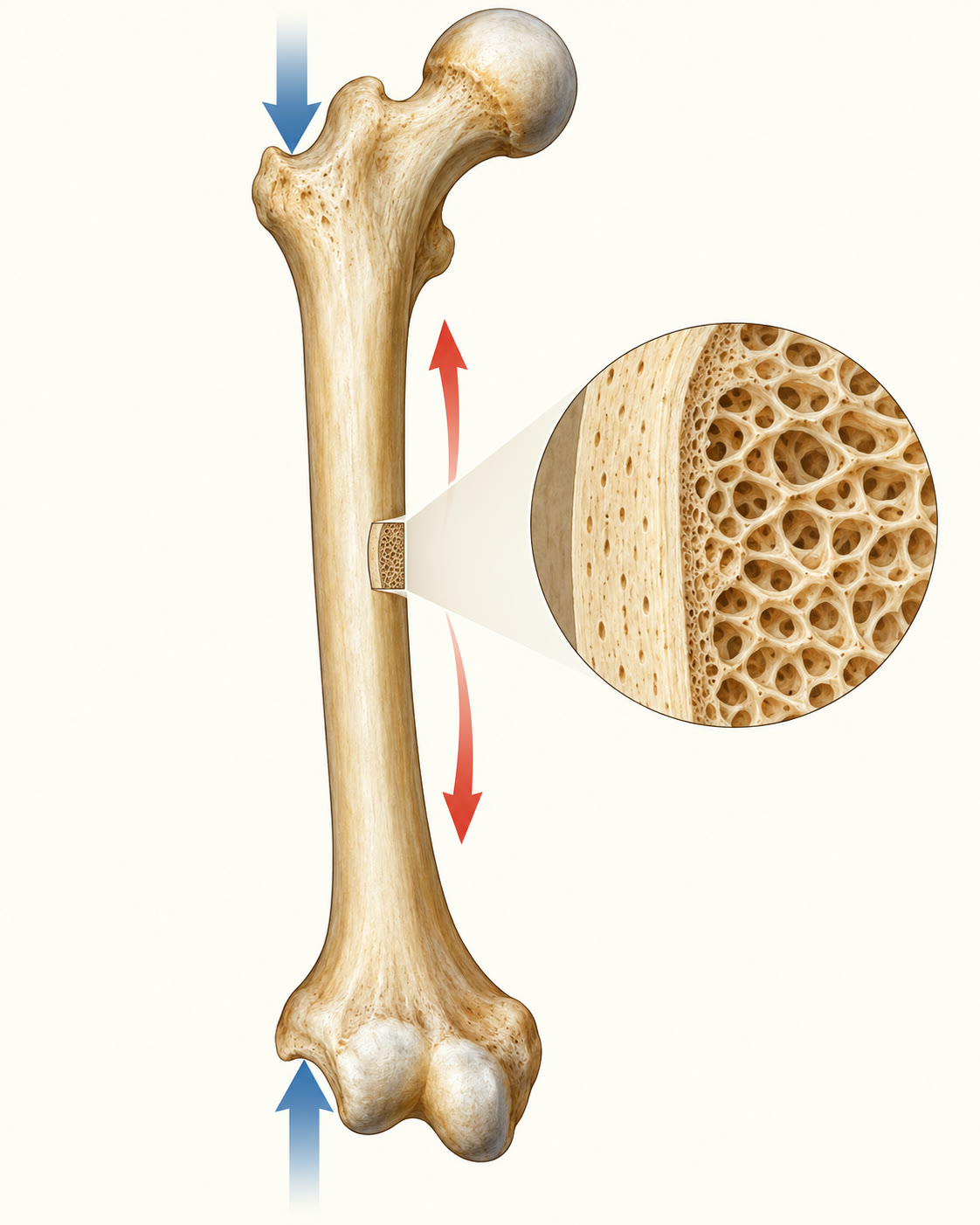
AI-generated conceptual illustration of a femur and loading directions; not a diagnostic image or numeric scale. Generated 2026-10-29. Prompt: “Vertical 4:5 educational scientific illustration of a human femur showing a small cross-section of dense outer cortical bone and porous inner bone, with subtle opposing arrows indicating compression along the long axis and a separate gentle pulling indication for tension. Museum textbook infographic style, realistic anatomical femur silhouette, clean cream background, muted bone and blue-red accents. No text, letters, numbers, labels, scale, comparison to other materials, or claims. Not a clinical image.”
In tests of human femoral cortical tissue, mean ultimate stress was about 205 MPa under compression and about 135 MPa under tension along the bone. So strength depends on the direction and type of loading; saying “bone is stronger than concrete and iron” hides important comparison conditions. These are laboratory values for tissue specimens, not a safe-load limit for an entire leg.