Black Holes, Accretion Disks, and Quasars
A black hole itself cannot be observed directly: light cannot escape from inside its event horizon. But gas and dust falling toward one can form an accretion disk. Gravity and friction heat the material, and the disk shines brightly. When a supermassive black hole is actively feeding, a galaxy’s central region can become a quasar—sometimes bright enough to outshine its entire host galaxy. The quasar’s light comes mainly from the black hole’s hot surroundings, not from the black hole itself.
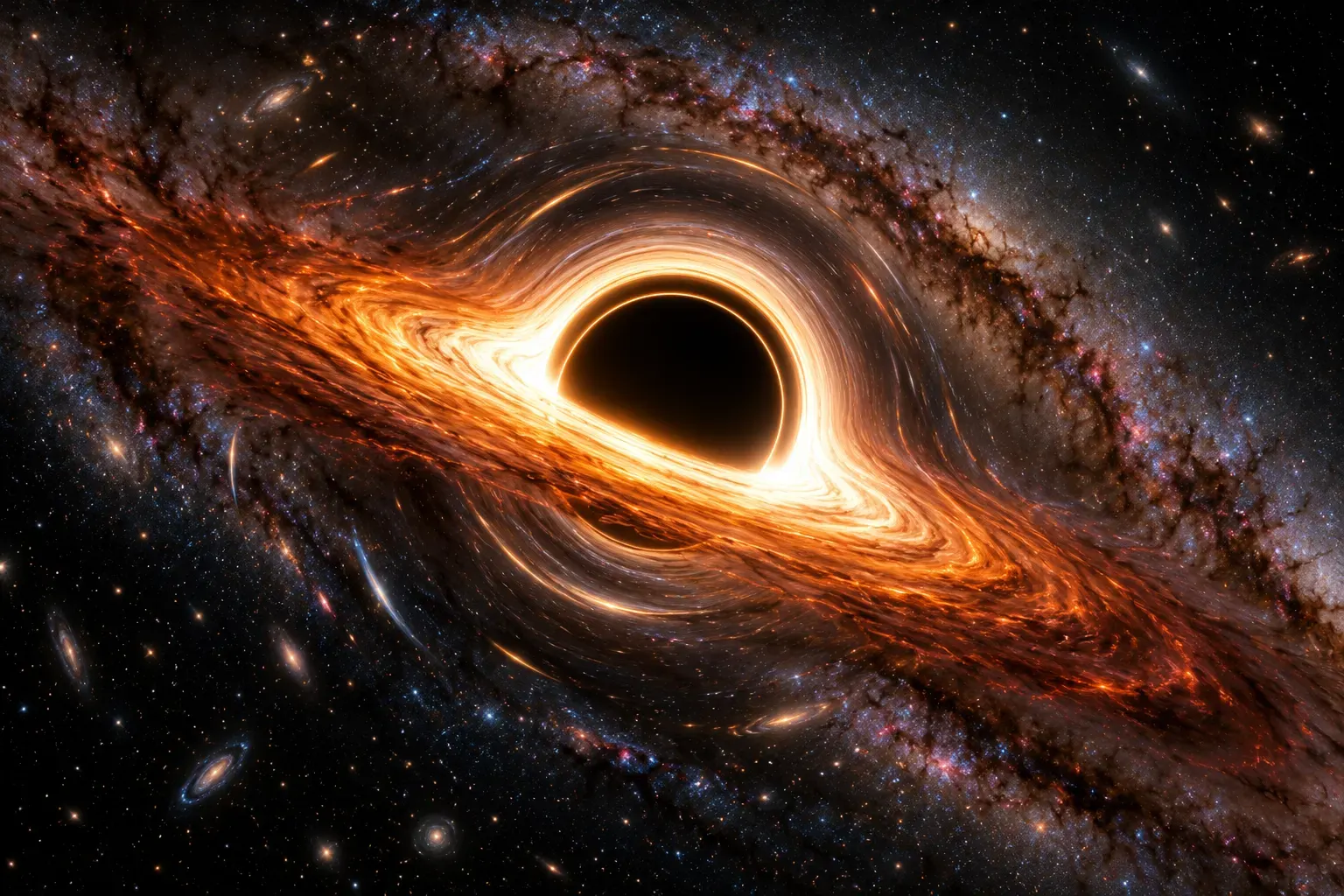
AI-generated illustration of an accretion disk, not an observation or scale-accurate model.