WattSearch
Your WattLeaderboard
Language
Autoplay narration
Appearance

Feedback

Have a question or an idea? Something not working? Send us a message.

What would you like to share?
Up to 3 files, 5 MB each, 12 MB total.
Or contact us directly

Direct contacts open a separate chat or email. Files attached here are not included.

arohalya@gmail.com
A little wonder, every day

Bellamy and payment cards
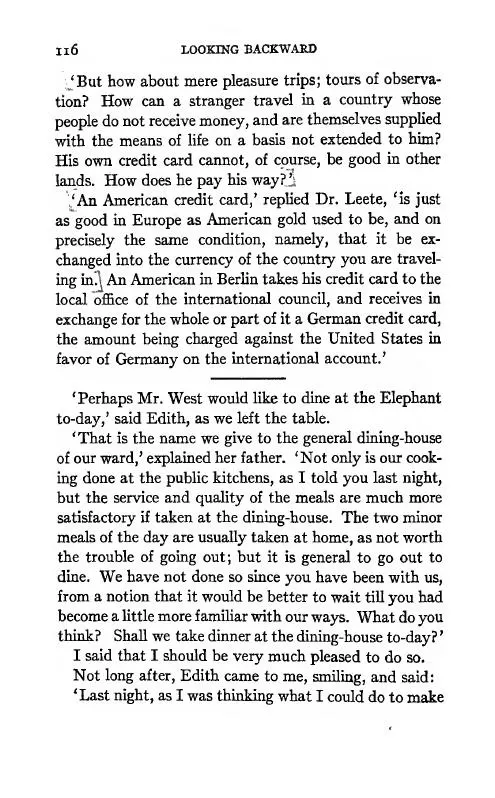
scanned page from Chapter X of a later reprint of Bellamy’s novel, showing the passage about exchanging credit cards for foreign travel. It is not represented as the 1888 first-edition page. Public-domain text/scan source; rendered from page 130 of the digitized volume; no content edits.
modern Diners Club sign and payment terminal photographed by Rakoon in 2016. It is contextual only and does not depict a historical card. CC0 1.0; no attribution required (courtesy credit retained); no edits.

scanned page from Chapter X of a later reprint of Bellamy’s novel, showing the passage about exchanging credit cards for foreign travel. It is not represented as the 1888 first-edition page. Public-domain text/scan source; rendered from page 130 of the digitized volume; no content edits.

Listen to fact0:00 / —

In *Looking Backward*, published in 1888, Edward Bellamy imagined a society where people used credit cards instead of cash. In his fictional world, a card could be exchanged for another country’s credit so its holder could pay abroad. Sixty-two calendar years after publication, in 1950, Diners Club launched a multipurpose payment card, but it was made of paper; plastic cards came later. This is an early literary parallel, not a description of a modern bank card.