WattSearch
Your WattLeaderboard
Language
Autoplay narration
Appearance

Feedback

Have a question or an idea? Something not working? Send us a message.

What would you like to share?
Up to 3 files, 5 MB each, 12 MB total.
Or contact us directly

Direct contacts open a separate chat or email. Files attached here are not included.

arohalya@gmail.com
A little wonder, every day

mortality risk after fame
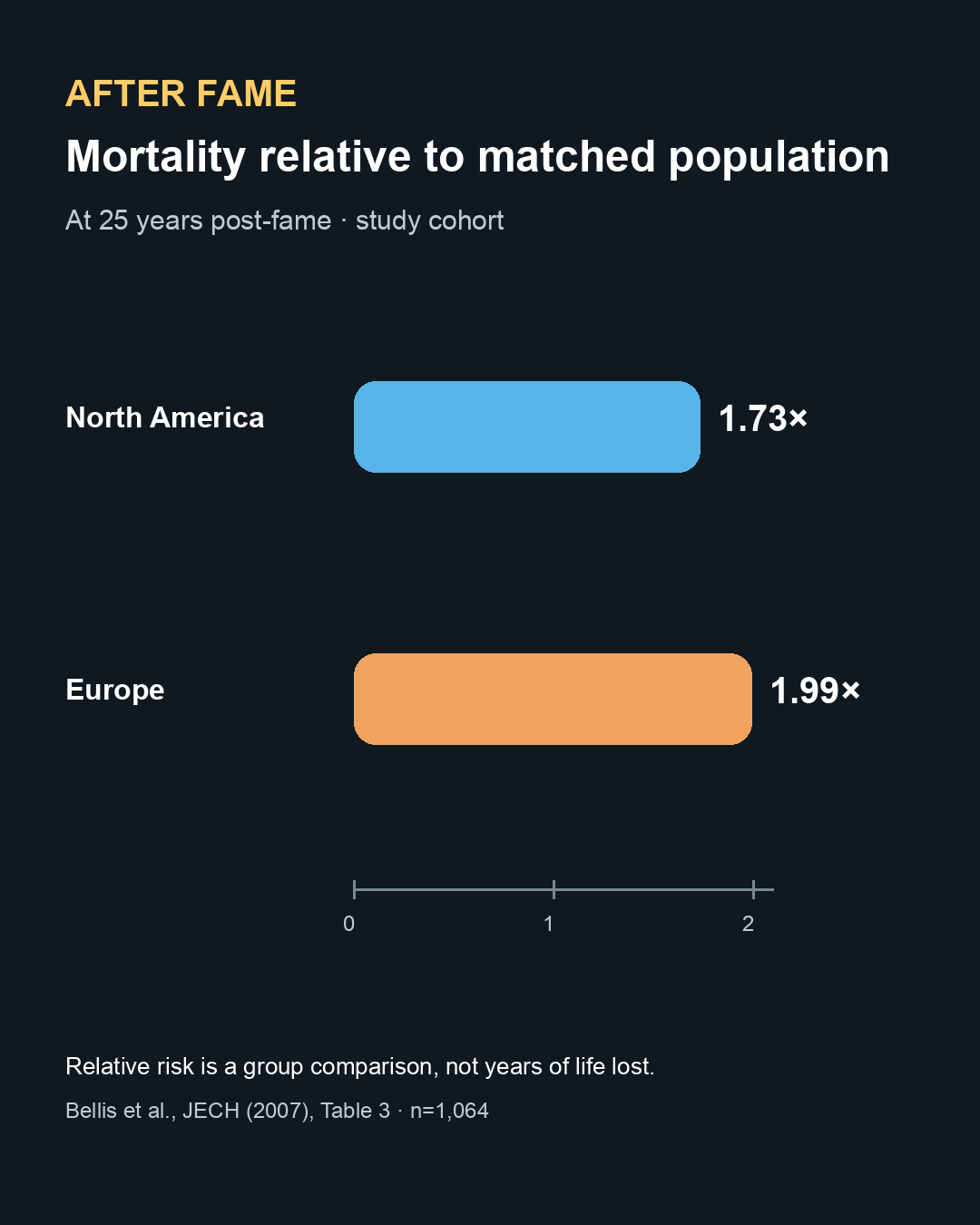
Original data graphic based on Table 3 in Bellis et al. (2007), showing the reported mortality ratios at 25 years post-fame (North America 1.73, Europe 1.99). Created for this package on 2026-10-25; no external image source. It represents relative mortality in the study cohort, not years of life lost.
Original explanatory diagram of the study sample and fame definition, based on Bellis et al. (2007). Created for this package on 2026-10-25; no external image source. No claims beyond the article's stated sample and methodology.

Original data graphic based on Table 3 in Bellis et al. (2007), showing the reported mortality ratios at 25 years post-fame (North America 1.73, Europe 1.99). Created for this package on 2026-10-25; no external image source. It represents relative mortality in the study cohort, not years of life lost.

Listen to fact0:00 / —

An Australian study of famous rock and pop musicians did not find that they died 25 years earlier on average. It found a different pattern: in a sample of 1,064 stars from North America and Europe, mortality was at least 1.7 times higher than in demographically matched populations from three to 25 years after fame. This is a risk measure for a specific sample, not a difference in each musician’s lifespan.