Binary stars: orbits and mass transfer
Binary and multiple-star systems are common; companions are especially frequent among massive stars. In a gravitationally bound binary, both stars move around a shared center of mass. Many binary systems remain stable for a long time, although their evolution depends on the stars’ separation, masses, and ages.
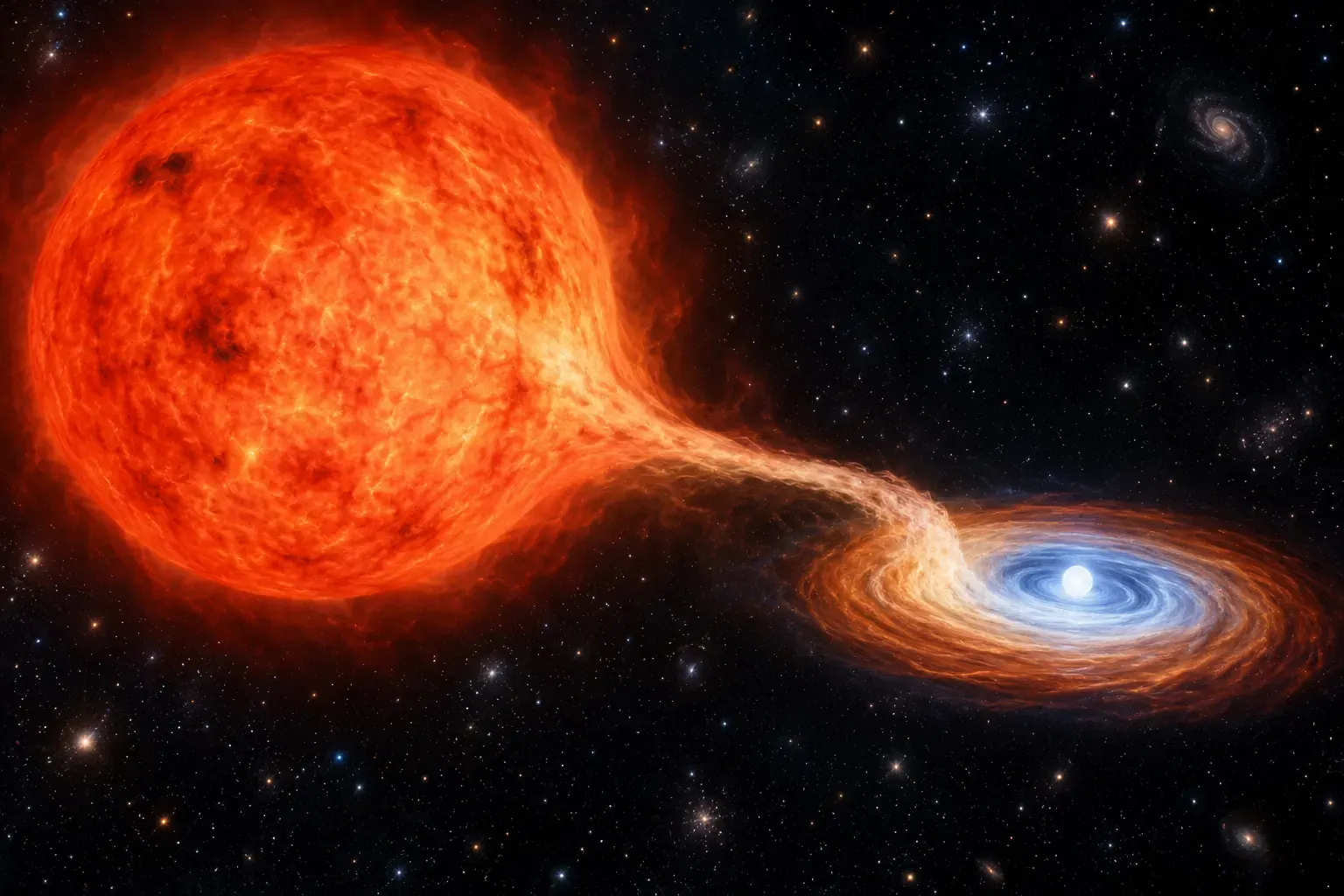
Illustration is AI-generated and conceptual, not a telescope observation.
In a close pair, material from one star’s outer layers can flow to its companion. The gas may form an accretion disk. If the companion is a white dwarf, hydrogen transferred from the other star can trigger a thermonuclear flash on its surface—a nova. Under other conditions, a white dwarf may explode as a Type Ia supernova. These are different events: a classical nova does not destroy the star, while a Type Ia supernova destroys the white dwarf.