WattSearch
Your WattLeaderboard
Language
Autoplay narration
Appearance

Feedback

Have a question or an idea? Something not working? Send us a message.

What would you like to share?
Up to 3 files, 5 MB each, 12 MB total.
Or contact us directly

Direct contacts open a separate chat or email. Files attached here are not included.

arohalya@gmail.com
A little wonder, every day

A digital bridge between brain and spinal cord
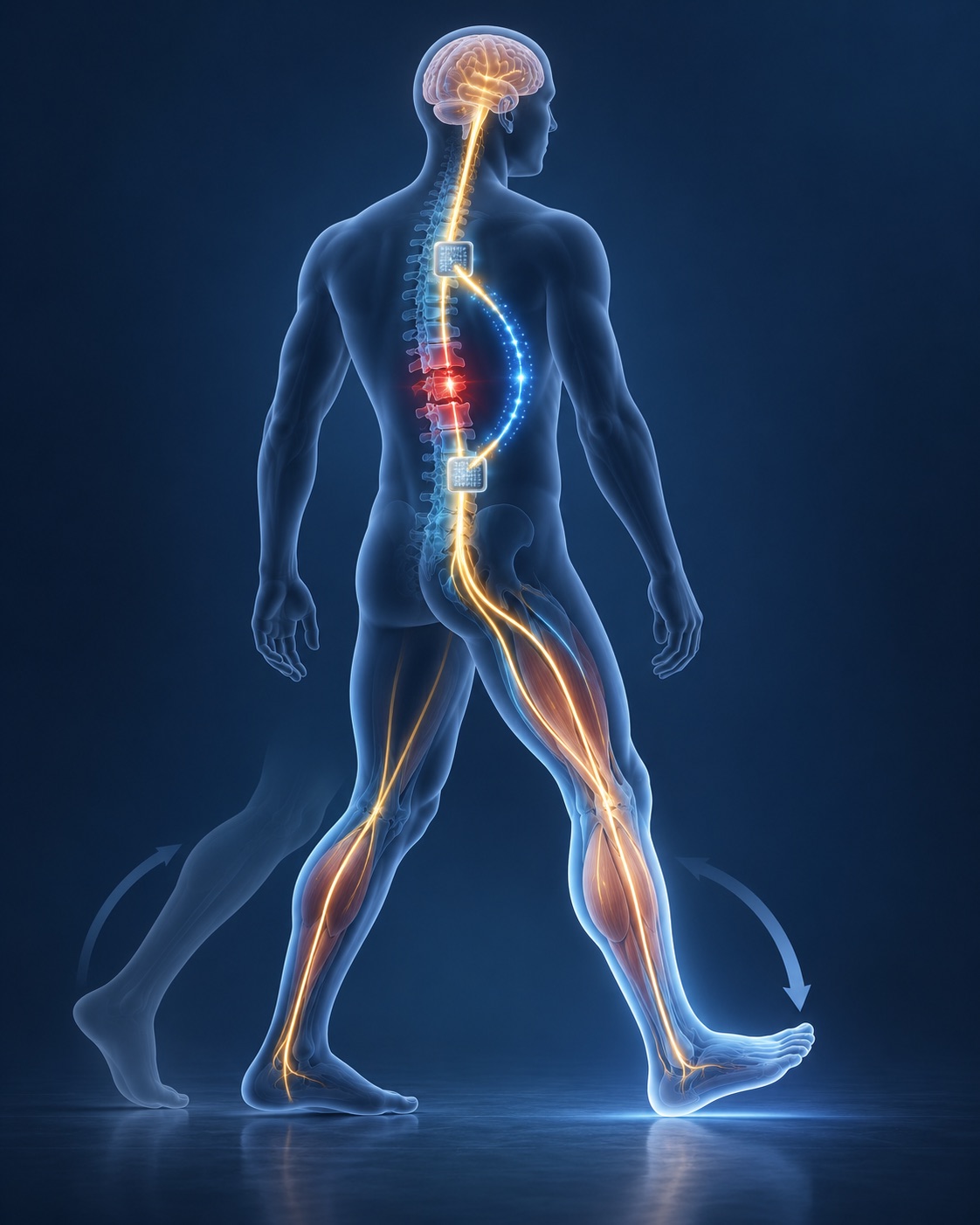
AI-generated conceptual medical-science illustration of an implanted brain–spine interface relaying movement intent around a spinal cord injury. It is not a photograph, scan, medical-device rendering, or depiction of the study participant. Prompt: “Conceptual educational medical-science illustration, not documentary: a neutral human silhouette with simplified brain and spinal cord, two small implanted electrode arrays connected by a luminous digital bridge that routes a movement signal around a highlighted spinal injury, subtle leg motion icons. Do not depict a real patient, surgical scene, actual device model, or measured data. No labels, text, or watermark. Clean museum-science illustration, vertical 4:5 composition.” Generated 2026-10-29; no external factual or documentary role.

AI-generated conceptual medical-science illustration of an implanted brain–spine interface relaying movement intent around a spinal cord injury. It is not a photograph, scan, medical-device rendering, or depiction of the study participant. Prompt: “Conceptual educational medical-science illustration, not documentary: a neutral human silhouette with simplified brain and spinal cord, two small implanted electrode arrays connected by a luminous digital bridge that routes a movement signal around a highlighted spinal injury, subtle leg motion icons. Do not depict a real patient, surgical scene, actual device model, or measured data. No labels, text, or watermark. Clean museum-science illustration, vertical 4:5 composition.” Generated 2026-10-29; no external factual or documentary role.

Listen to fact0:00 / —

In 2023, researchers described a brain–spine interface that relayed the brain’s intention to move to a stimulator on the spinal cord, bypassing the injury site. A participant with a chronic spinal cord injury was able to stand and walk with the system. This was a study involving one person, not a ready-made universal treatment for paralysis.