The Hourglass: More Than a Clock
The hourglass was useful whenever people needed to measure an interval without a mechanical clock. At sea, sandglasses marked watches and the intervals between ship’s-bell signals; in churches, pulpit glasses limited sermon length. Sources also describe household use for cooking.
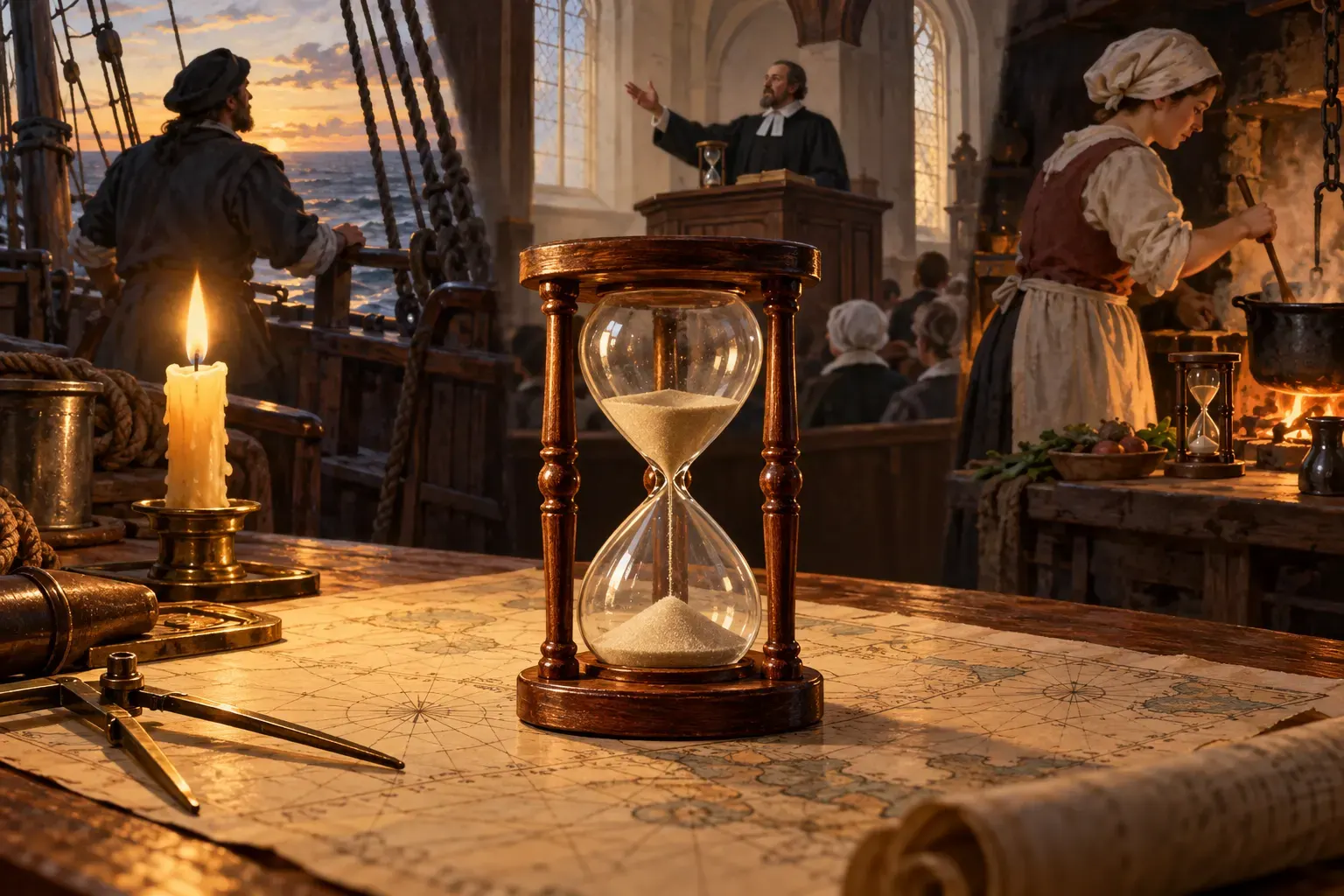
That did not make every glass equally accurate. Timing depended on the granular material, the ratio between grain size and neck width, the volume and shape of the bulbs, moisture, and whether the glass stood level. An hourglass was therefore a simple timer for a set interval, not a universally precise clock. The claim that hourglasses timed medical procedures has only limited support: a museum describes one 15-second example as a possible pulse-timing instrument, while explicitly treating that identification as uncertain.