Bacteria are not 70% of Earth’s biomass
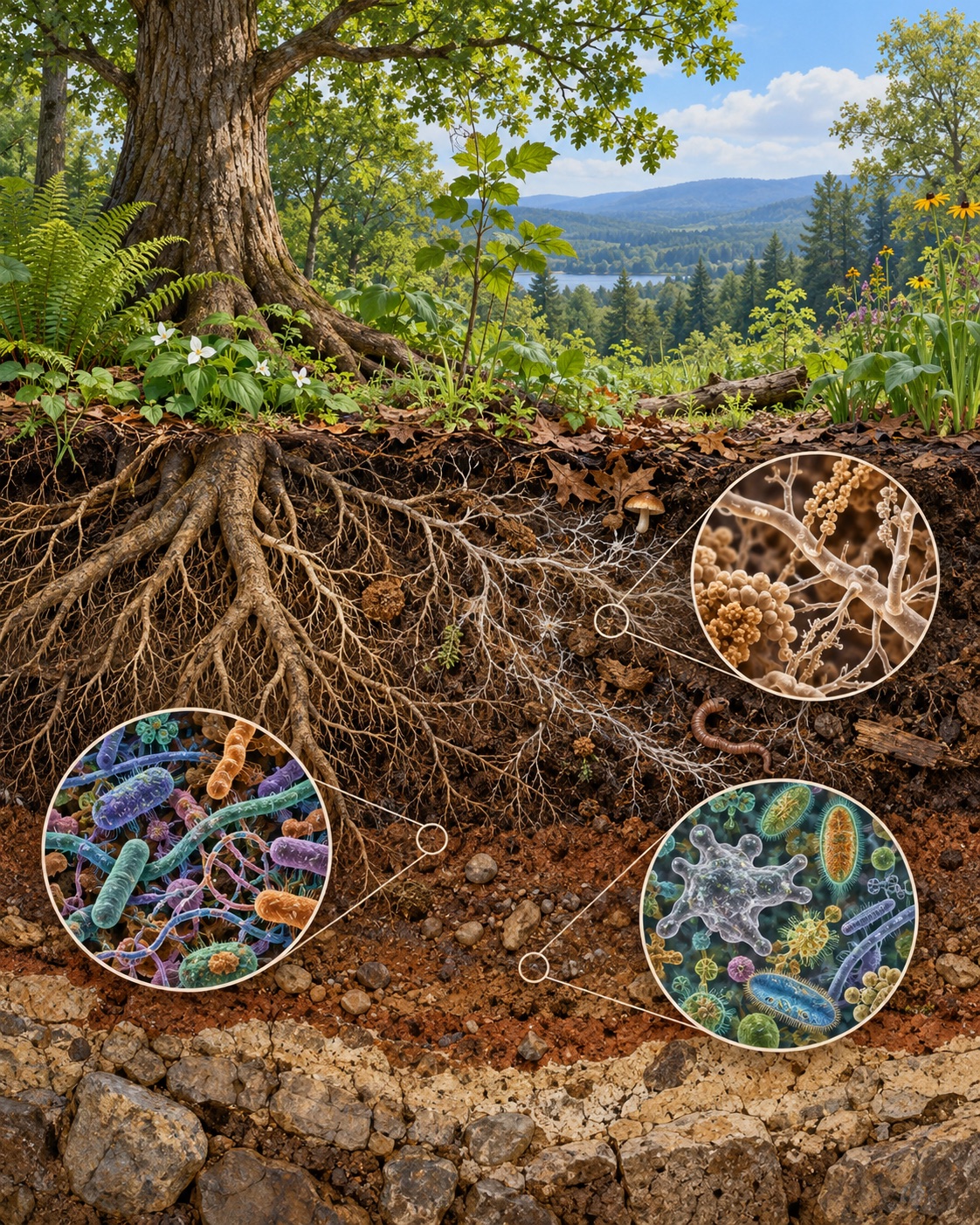
AI-generated conceptual illustration contrasting terrestrial plant biomass and a magnified soil microbe community. It does not encode relative quantities or act as a data chart. Prompt: “Educational natural history illustration, vertical 4:5. A cross-section view combining a living terrestrial landscape and its soil: large trees and green plants above ground, intricate soil layers below with numerous tiny bacteria-like microorganisms shown in magnified artistic detail. Convey that plant biomass is extensive and microbes are numerous but do not visually imply exact proportional amounts. Museum science illustration, realistic but conceptual, earthy palette, clear scale transition with a magnifying effect. No text, labels, numbers, pie chart, or data markings. Not documentary imagery.” Generated 2026-10-29; no external source or documentary role.
A global biomass census published in 2018 estimated about 550 gigatonnes of carbon in all living organisms. Bacteria accounted for about 70 gigatonnes—roughly 15% of that amount—while plants accounted for about 450 gigatonnes. These are estimates of carbon mass in living organisms, not their total wet mass; the authors also reported very large uncertainty for bacteria.