WattSearch
Your WattLeaderboard
Language
Autoplay narration
Appearance

Feedback

Have a question or an idea? Something not working? Send us a message.

What would you like to share?
Up to 3 files, 5 MB each, 12 MB total.
Or contact us directly

Direct contacts open a separate chat or email. Files attached here are not included.

arohalya@gmail.com
A little wonder, every day

A fennec’s large ears help release heat
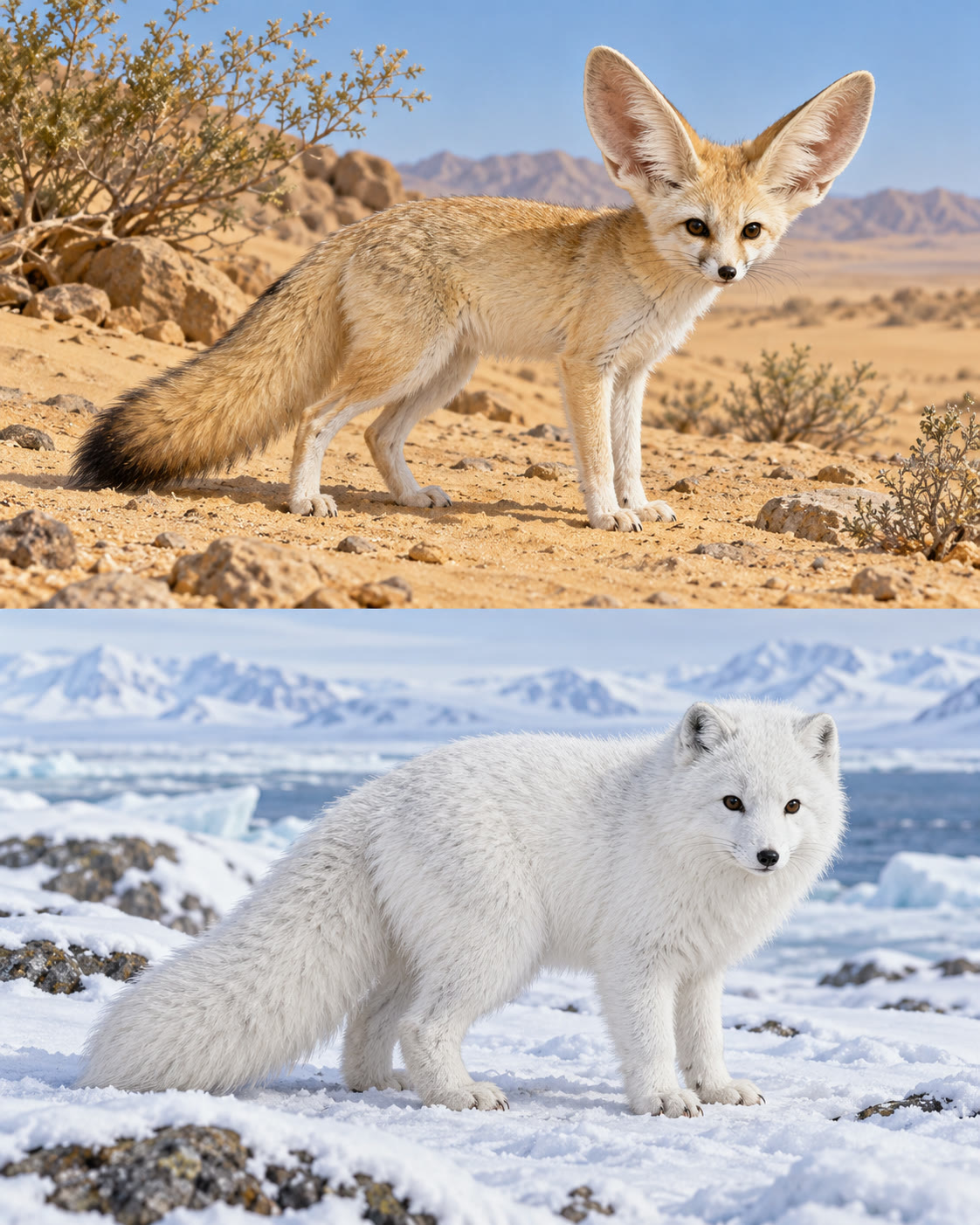
AI-generated conceptual contrast of desert and arctic foxes; it is illustrative, not a measurement or proof of a universal rule. Generated 2026-10-29. Prompt: “Vertical 4:5 natural history comparison illustration: a desert fennec fox with large ears and an arctic fox with small ears in their contrasting environments, accurate species silhouettes, scientific museum field guide style. Convey anatomical variation without implying all animals follow a universal rule. No text, labels, numbers, or arrows.”

AI-generated conceptual contrast of desert and arctic foxes; it is illustrative, not a measurement or proof of a universal rule. Generated 2026-10-29. Prompt: “Vertical 4:5 natural history comparison illustration: a desert fennec fox with large ears and an arctic fox with small ears in their contrasting environments, accurate species silhouettes, scientific museum field guide style. Convey anatomical variation without implying all animals follow a universal rule. No text, labels, numbers, or arrows.”

Listen to fact0:00 / —

In some warm-blooded animals, long projecting body parts can release more heat. This illustrates Allen’s rule: in cold environments, appendages are often shorter relative to body size. For example, a fennec’s large ears help it release heat and hear prey beneath the sand. This is a pattern, not a universal rule for the colour and shape of all animals.