WattSearch
Your WattLeaderboard
Language
Autoplay narration
Appearance

Feedback

Have a question or an idea? Something not working? Send us a message.

What would you like to share?
Up to 3 files, 5 MB each, 12 MB total.
Or contact us directly

Direct contacts open a separate chat or email. Files attached here are not included.

arohalya@gmail.com
A little wonder, every day

Gutenberg’s printing system
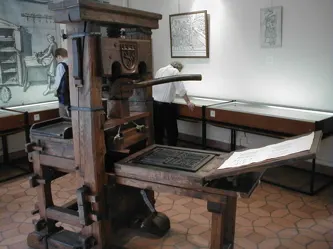
photograph of a reconstructed Gutenberg-era press on display at the Printing History Museum, Lyon; Wikimedia Commons file page identifies the depicted object as a reproduction; uploader Ghw released the photograph into the public domain. https://commons.wikimedia.org/wiki/File:Gutenberg.press.jpg. Labeled as a reconstruction, not Gutenberg’s surviving original.
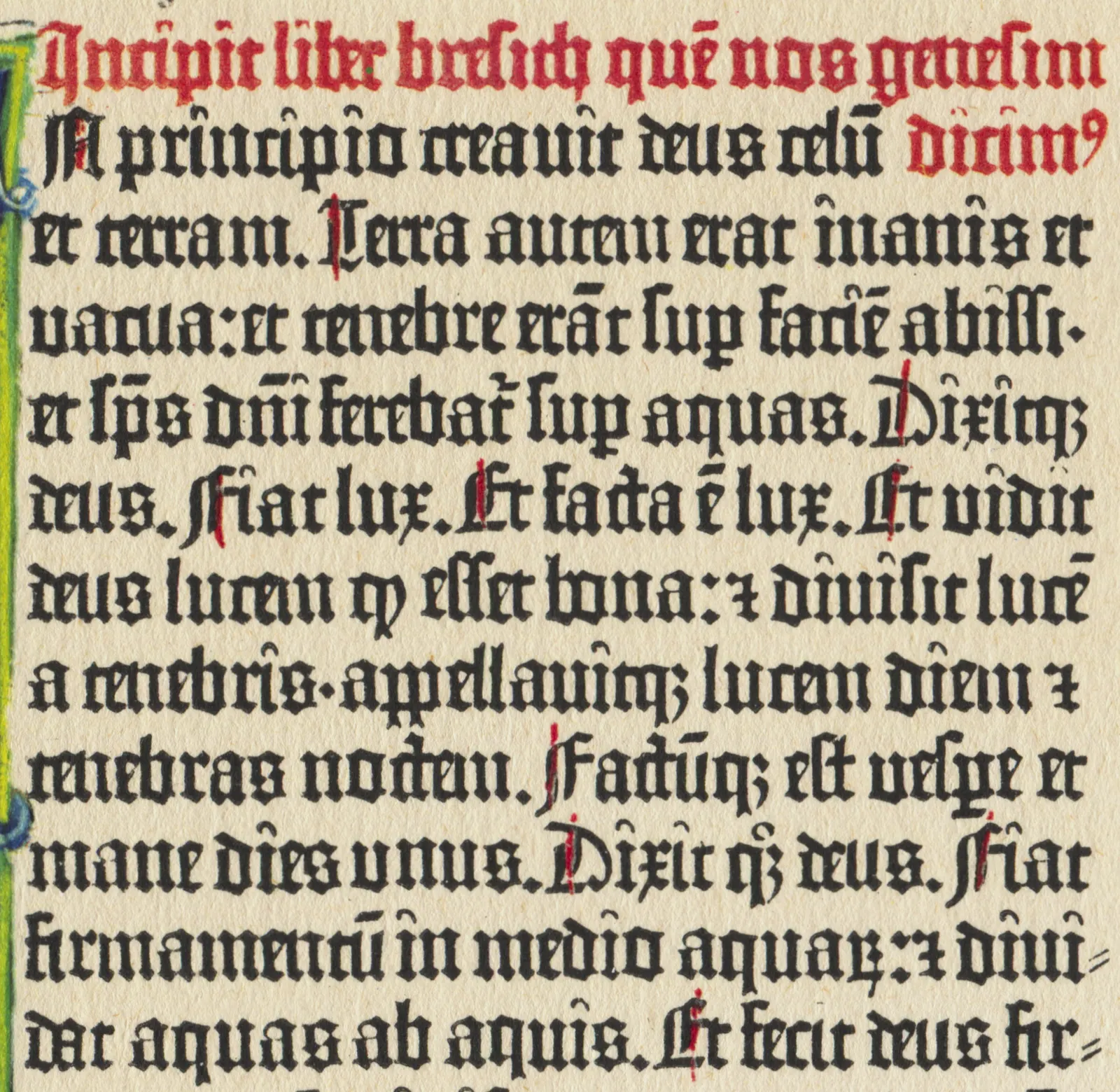
digitized page from the 42-line Gutenberg Bible, fol. 5r, Staatsbibliothek zu Berlin illuminated copy; original printed c. 1454–1455 by Gutenberg; public domain. https://commons.wikimedia.org/wiki/File:Gutenberg_Bible_B42_Genesis_cropped.jpg.

photograph of a reconstructed Gutenberg-era press on display at the Printing History Museum, Lyon; Wikimedia Commons file page identifies the depicted object as a reproduction; uploader Ghw released the photograph into the public domain. https://commons.wikimedia.org/wiki/File:Gutenberg.press.jpg. Labeled as a reconstruction, not Gutenberg’s surviving original.

Listen to fact0:00 / —

In the mid-fifteenth century in Mainz, Johannes Gutenberg combined movable metal type, a hand mould for casting it, and a screw press that evenly pressed paper against the inked type. This mechanical transfer of the image sped printing up compared with rubbing a sheet by hand. Movable type had been used earlier in China, and by 1377 a surviving book had already been printed with metal type in Korea; Gutenberg’s system was novel not because it invented movable type, but because it combined and mechanized the printing process in Europe.