Hornsdale’s 100-day battery challenge
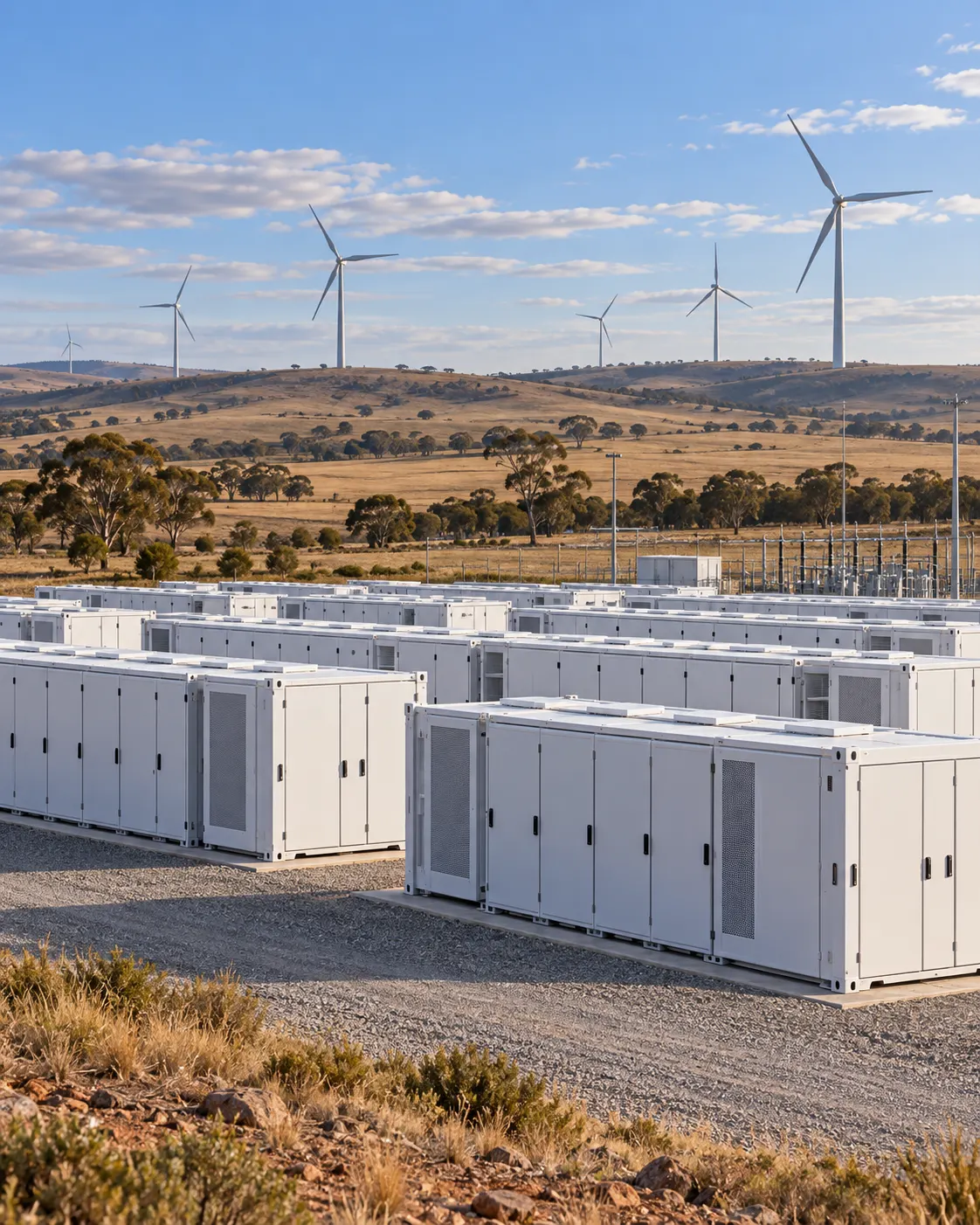
AI-generated conceptual illustration of a generic utility-scale battery with wind turbines in rural South Australia. Generated 2026-10-20 with OpenAI Image Generation. Prompt: “Create a realistic editorial illustration, vertical 4:5, of a generic grid-scale lithium-ion battery storage installation in the rural South Australian landscape: rows of neutral unbranded white modular battery containers, wind turbines in the distance, subdued natural daylight, no readable labels, no logos, no recognizable real people. It must be clearly a conceptual visualization, not an archival photograph and not an exact depiction of Hornsdale Power Reserve.” This is not documentary evidence or an exact image of Hornsdale.
In March 2017, Elon Musk wrote that Tesla could bring a large lithium-ion battery online in South Australia within 100 days or it would be free. The government agreement specified that the clock would start after the grid-connection agreement was signed; the Hornsdale Power Reserve began operating on December 1, 2017, about 40 days before the deadline. In a first-year report, independent consultant Aurecon estimated that the battery could enable nearly 40 million Australian dollars in annual wholesale-market savings through increased competition and removal of a local constraint on reserve services. This was an estimate of savings for the market, not evidence that investors recovered 80% of their investment within a year.