When an Active Sun Affects Earth
A solar flare is a brief burst of radiation; a coronal mass ejection (CME) is a large cloud of plasma and magnetic field. They can occur together, but they are distinct phenomena, and not every flare comes with a CME. X-rays from a strong flare can quickly disrupt high-frequency radio communications on Earth’s sunlit side. If an Earth-directed CME arrives and interacts with the magnetosphere, it can trigger a geomagnetic storm.
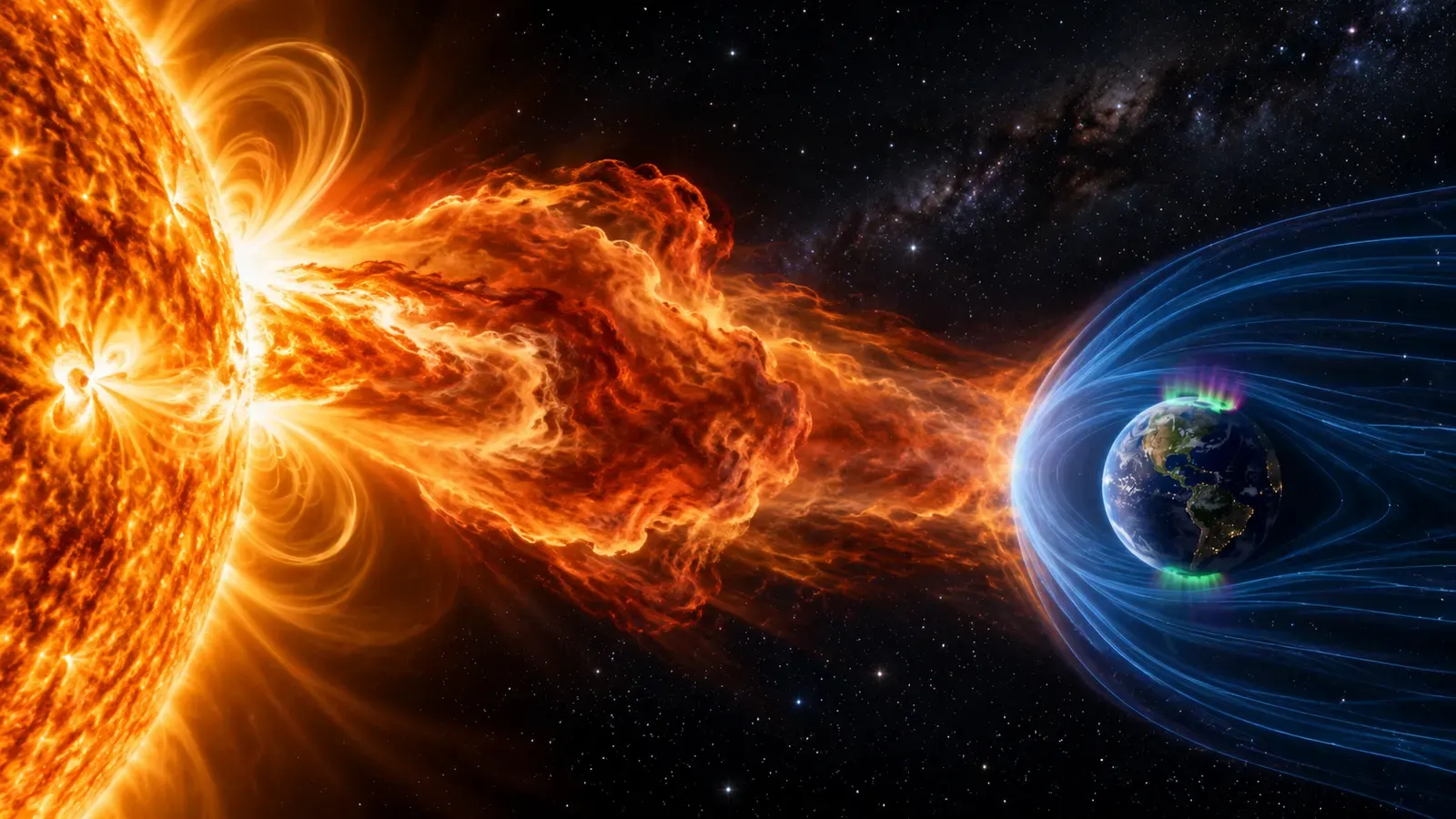
Such a storm can intensify auroras, degrade GPS/GNSS accuracy and satellite signals, affect radio communications, and induce currents in power grids. Grid effects depend on storm severity and range from manageable operational adjustments to serious disruption in rare extreme events. Earth’s average distance from the Sun is about 150 million kilometres.
Researchers study possible links between solar and geomagnetic activity and some health measures, but findings are heterogeneous and methodologically limited. There is no convincing evidence that ordinary variations in solar activity noticeably worsen the wellbeing of most people.