WattSearch
Your WattLeaderboard
Language
Autoplay narration
Appearance

Feedback

Have a question or an idea? Something not working? Send us a message.

What would you like to share?
Up to 3 files, 5 MB each, 12 MB total.
Or contact us directly

Direct contacts open a separate chat or email. Files attached here are not included.

arohalya@gmail.com
A little wonder, every day

Babbage and Turing: machinery and theory
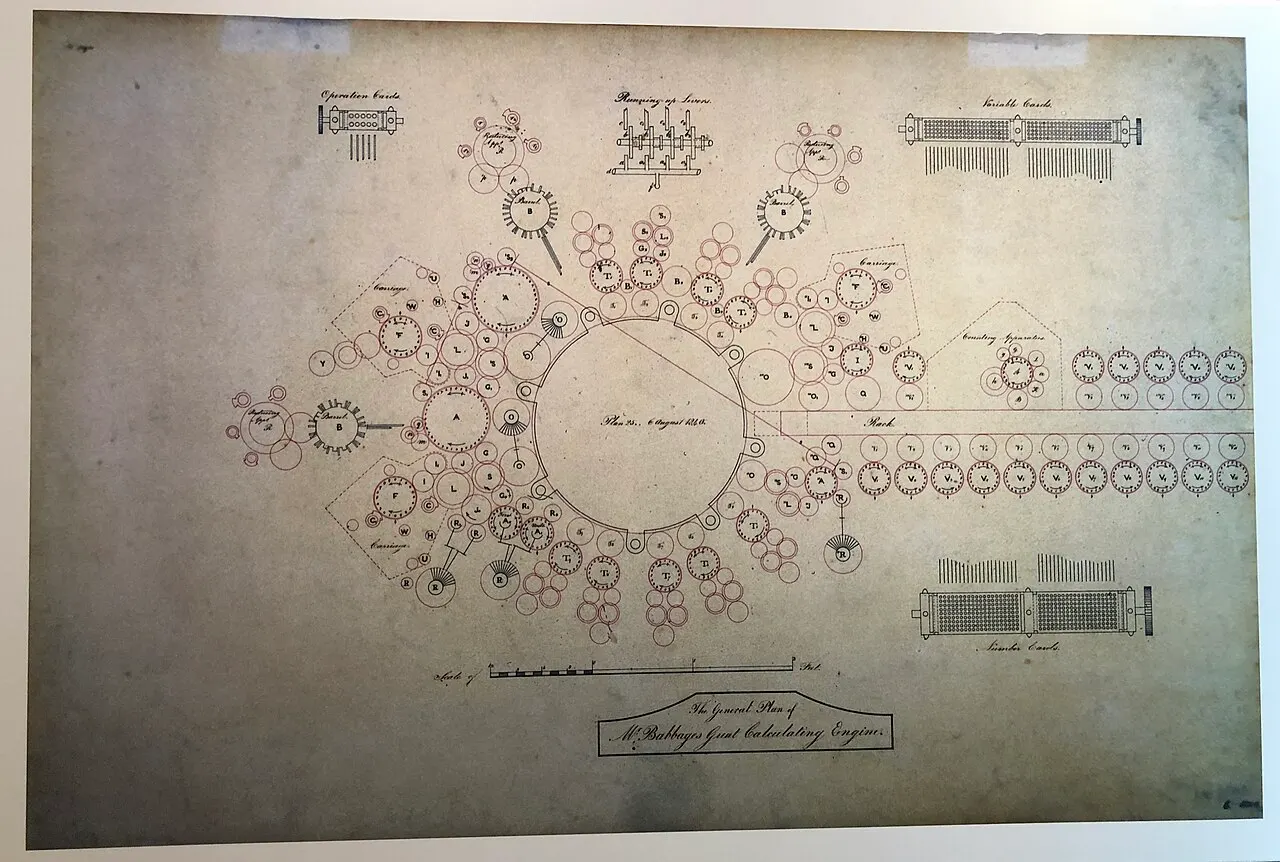
Історичний план Аналітичної машини Беббіджа 1840 року; проєкт, не фото завершеного комп’ютера / Historical 1840 plan for Babbage’s Analytical Engine; a design, not a photograph of a completed computer. Credit: ArnoldReinhold; CC BY 4.0. https://creativecommons.org/licenses/by/4.0 Source: https://commons.wikimedia.org/?curid=69497631
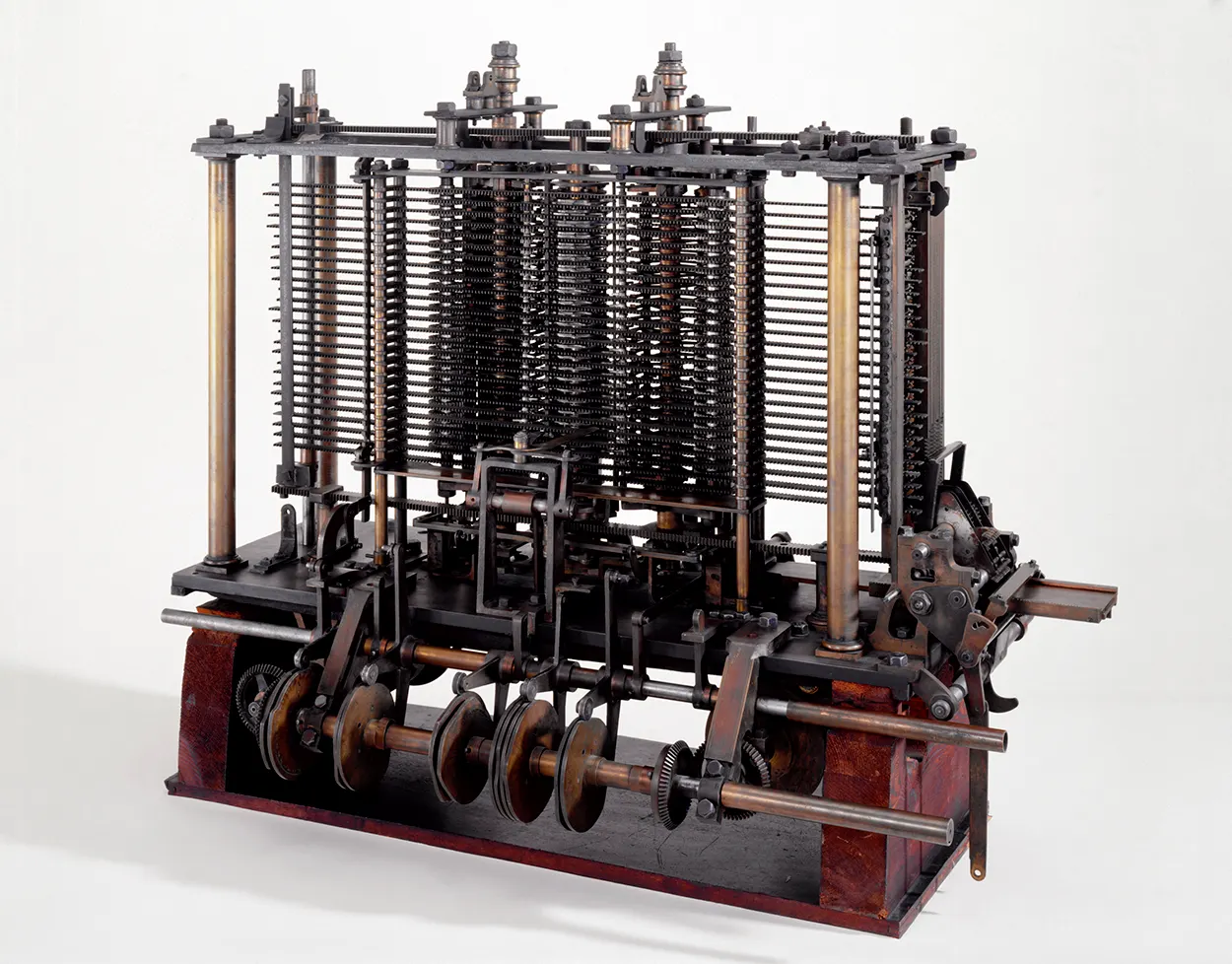
Збережена частина Аналітичної машини Беббіджа, музейний експонат; не повністю завершена універсальна машина / Surviving part of Babbage’s Analytical Engine, a museum object; not a fully completed universal machine. Credit: Charles Babbage; CC BY-SA 2.0. https://creativecommons.org/licenses/by-sa/2.0 Source: https://commons.wikimedia.org/?curid=28024313

Історичний план Аналітичної машини Беббіджа 1840 року; проєкт, не фото завершеного комп’ютера / Historical 1840 plan for Babbage’s Analytical Engine; a design, not a photograph of a completed computer. Credit: ArnoldReinhold; CC BY 4.0. https://creativecommons.org/licenses/by/4.0 Source: https://commons.wikimedia.org/?curid=69497631

Listen to fact0:00 / —

In the nineteenth century Charles Babbage designed mechanical computing machines: a Difference Engine for tables and an Analytical Engine as a programmable machine for broader tasks. A complete Analytical Engine was not built during his lifetime. In 1936 Alan Turing formulated a theoretical model of stepwise computation and a universal machine able to simulate other machines within that model. These were important but different contributions: a mechanical design, a mathematical model and a later electronic computer are not one invention on a single date.