WattSearch
Your WattLeaderboard
Language
Autoplay narration
Appearance

Feedback

Have a question or an idea? Something not working? Send us a message.

What would you like to share?
Up to 3 files, 5 MB each, 12 MB total.
Or contact us directly

Direct contacts open a separate chat or email. Files attached here are not included.

arohalya@gmail.com
A little wonder, every day

The hoof code of equestrian statues
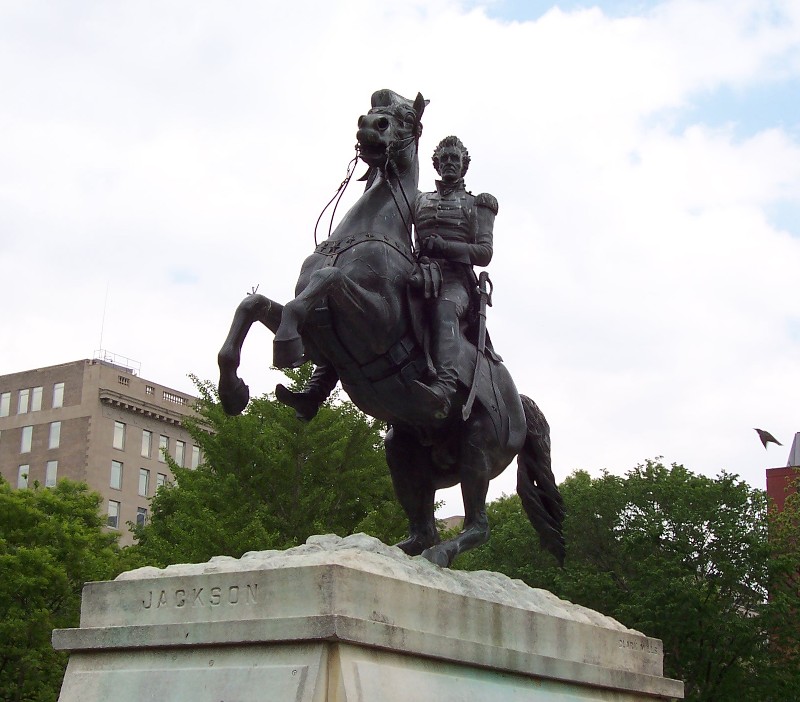

Andrew Jackson’s equestrian statue in Lafayette Square, Washington, D.C.; photograph by Ed Brown (Edbrown05), 2005; released into the public domain by its author. Original file page: https://commons.wikimedia.org/wiki/File:Andrew_Jackson_statue.jpg. No attribution required; credit Ed Brown where practical. Downloaded 2026-10-28; no edits.
Peter the Great’s “Bronze Horseman” in Saint Petersburg; photograph by W. Bulach, 2010; CC BY-SA 4.0. Credit W. Bulach, Wikimedia Commons; link to https://creativecommons.org/licenses/by-sa/4.0; no edits. Original file page: https://commons.wikimedia.org/wiki/File:00_5062_Saint_Petersburg_-_The_equestrian_statue_of_Tsar_Peter_the_Great_%28The_Bronze_Horseman%29.jpg. Downloaded the 1,280 px Commons version on 2026-10-28.

Andrew Jackson’s equestrian statue in Lafayette Square, Washington, D.C.; photograph by Ed Brown (Edbrown05), 2005; released into the public domain by its author. Original file page: https://commons.wikimedia.org/wiki/File:Andrew_Jackson_statue.jpg. No attribution required; credit Ed Brown where practical. Downloaded 2026-10-28; no edits.

Listen to fact0:00 / —

A popular belief assigns a secret code to equestrian statues: a rearing horse supposedly means the rider died in battle; one raised hoof means death from battle wounds; all hooves on the ground mean a natural death. But there is no reliable universal rule: the Australian War Memorial calls this pattern an urban myth. For example, the horse on Andrew Jackson’s statue rears, although Jackson died of natural causes.