What happens near a black hole
. Credit NASA’s Goddard Space Flight Center/Jeremy Schnittman and Brian Powell. NASA media usage guidance: [Images and Media](https://www.nasa.gov/nasa-brand-center/images-and-media/). Downloaded 2026-10-16 as the original JPEG still, without edits. Simulation, not a photograph or direct observation.](https://xtotam-watt-media-442809139467.s3.eu-central-1.amazonaws.com/facts/ddefb0d6-903f-41a4-a633-162b28f9b406/media/1f960a74479e0491b28d2913744028d036250217b7f27c8da60277cea1476125/nasa-black-hole-simulation-still.webp)
. Reproduced from ESO material under [CC BY 4.0](https://creativecommons.org/licenses/by/4.0/). Credit “EHT Collaboration / European Southern Observatory (ESO)” and link the license. Original 4076 × 4076 JPEG downloaded 2026-10-19 without edits. Interferometric reconstruction, not an ordinary camera photograph.](https://xtotam-watt-media-442809139467.s3.eu-central-1.amazonaws.com/facts/ddefb0d6-903f-41a4-a633-162b28f9b406/media/9373a684818ad1b74dae0dddcaeb9ae21a2ae021a807f51e332101fc86028227/sagittarius-a-eht-image.webp)
.](https://xtotam-watt-media-442809139467.s3.eu-central-1.amazonaws.com/facts/ddefb0d6-903f-41a4-a633-162b28f9b406/media/c902b63107e6e577d747dc185688866d5137265f5d1ca5a76d6a9a6ecb001226/event-horizon-one-way-schematic.webp)
; NASA Imagine the Universe, [“The Anatomy of Black Holes”](https://imagine.gsfc.nasa.gov/educators/blackholes/imagine/page8.html).](https://xtotam-watt-media-442809139467.s3.eu-central-1.amazonaws.com/facts/ddefb0d6-903f-41a4-a633-162b28f9b406/media/17c83446ccb6674714ec34da35992e7d823eafcefc390f9d3a280c71a6373681/black-hole-tidal-forces-by-mass.webp)
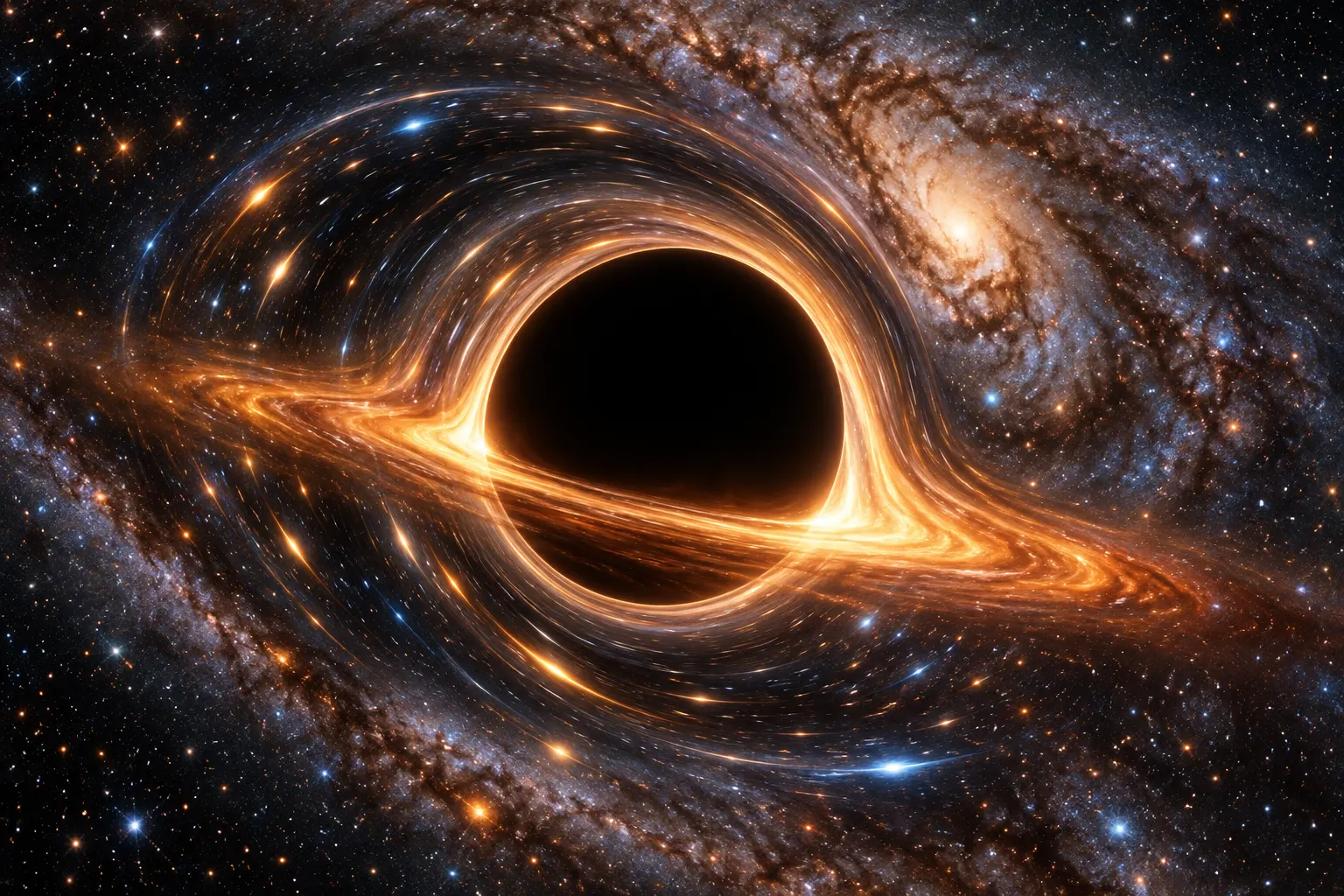
**AI-generated cover**. Realistic conceptual rendering of a black hole with a dark event-horizon silhouette and curved light paths. It is not an image of Sagittarius A* or a scientific observation. The exact prompt and generation date were not preserved in the existing package record; no source image assets were documented.
The supermassive black hole Sagittarius A* lies at the center of the Milky Way. Beyond its event horizon, neither light nor a signal can escape. But saying that any life must die instantly at the boundary is too categorical: near the horizon of a very massive black hole, tidal forces can be weaker, so in theory a traveler could cross without noticing the boundary at that moment. Escape would then be impossible, and tidal forces would eventually destroy the body.