Why some moai appear to be only heads
. Visually checked. It illustrates the landscape and partially buried statues; it is not the 1919 excavation photograph.](https://xtotam-watt-media-442809139467.s3.eu-central-1.amazonaws.com/facts/eb652007-3560-4d0a-a764-95847322d87f/media/f1627c5d936632befb0ca3ac9522754e7cdab42fef960429722e23b8b516e375/rano-raraku-standing-moai.jpg)
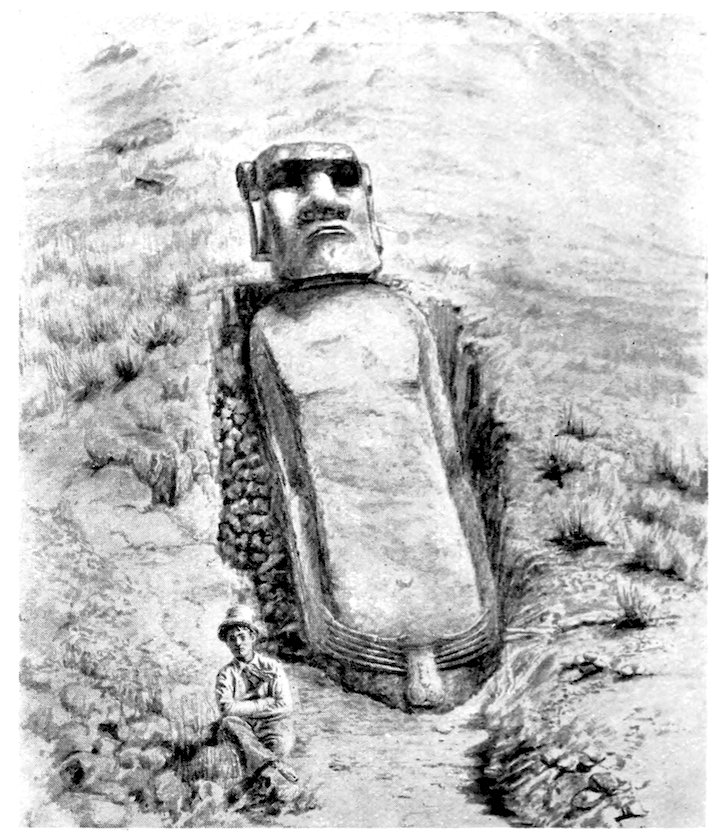
sketch of an excavated moai at Rano Raraku, published as figure 69 in Katherine Routledge's 1919 expedition account. The torso shown beneath the exposed head illustrates early documentation of buried statue bodies.
The famous “stone heads” of Rapa Nui, or Easter Island, are often partially buried moai statues. On the slopes of the Rano Raraku quarry, soil and deposits hide the bodies of many figures, leaving heads and shoulders exposed. Excavations reveal torsos with arms beneath them: these are not separate heads to which someone later attached bodies.
Nor is this a sensational discovery of recent years. Such bodies were documented in earlier investigations, including the 1914–1915 expedition. New excavations help explain particular objects and their surroundings, rather than proving for the first time that moai can have hidden bodies. This also does not mean that a complete statue necessarily lies beneath every head fragment.