Nollet's Electricity Experiment with Monks
In 1746, French physicist Jean-Antoine Nollet demonstrated an electrical discharge through a human chain of about 200 Carthusian monks. A historical account says the participants were linked hand to hand, with iron wires between them forming a circuit about 5,400 feet (roughly 1.65 km) around. Nollet discharged a battery of Leyden jars, and the people reacted to the shock nearly simultaneously.
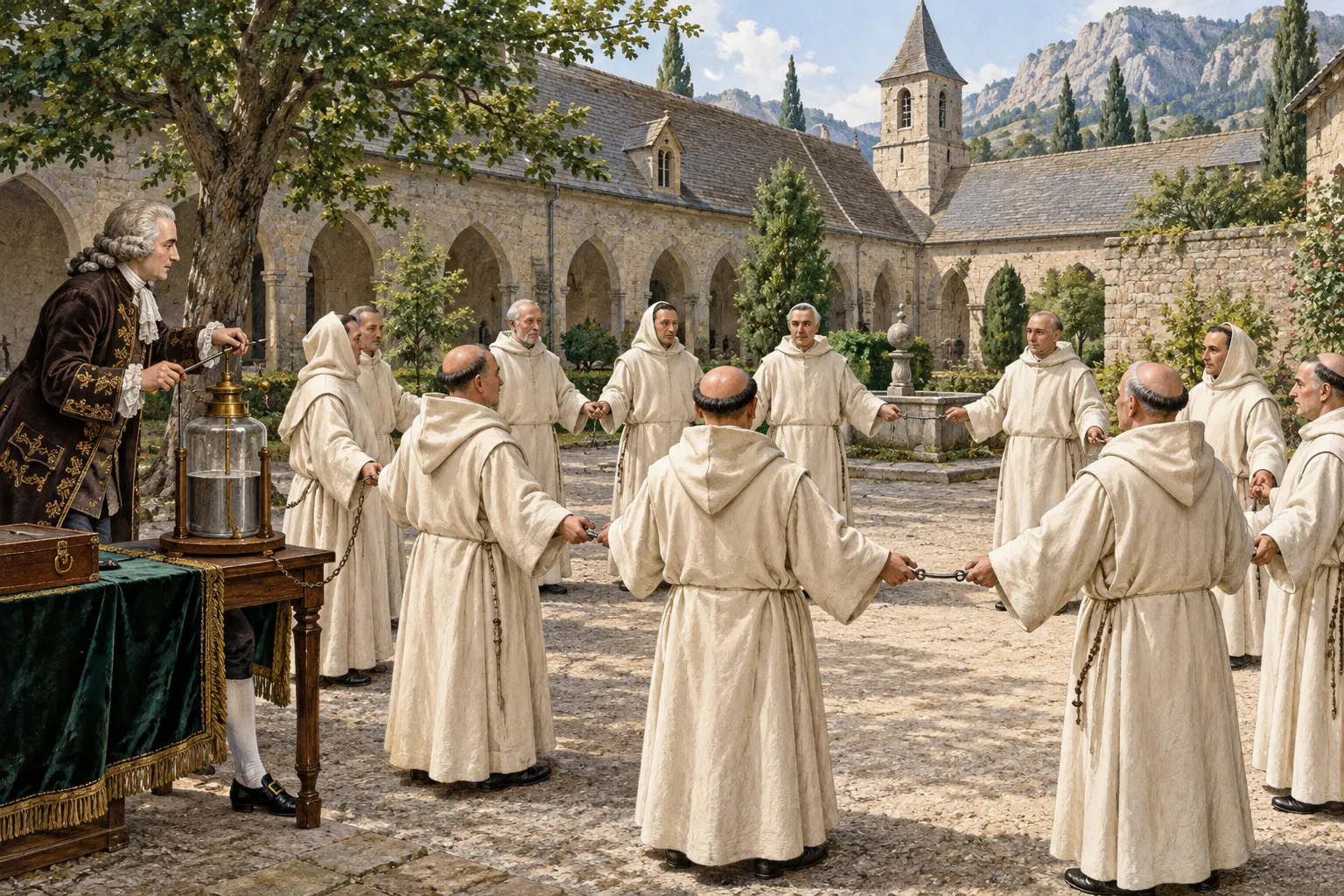
The demonstration showed that the electrical effect propagated extremely quickly over that distance, but it did not measure the exact speed of electric current. Near-simultaneous human reactions in an experiment with limited timing precision are not a precise measurement method. In modern electrical engineering, signal speed in a circuit depends on the conductor and surrounding medium, not on the drift speed of individual electrons.